Product Description

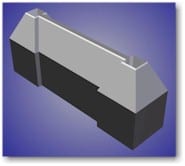
The CCSi ASTM D1329 63 mm Specimen Cutting Die produces 63 mm circular test specimens for laboratories performing ASTM D1329, testing on thermal insulating materials.

Designed for demanding laboratory environments, the die combines premium American tool steel with precision Wire EDM manufacturing to produce clean, accurate cuts while maintaining excellent edge geometry over years of service. Because the cutting walls remain perfectly vertical, the die can be resharpened multiple times without changing specimen dimensions.

The larger 63 mm specimen size makes this die well suited for ASTM D1329 applications requiring larger test samples while maintaining strict dimensional consistency.

Each die includes:

  • Precision 63 mm cutting geometry
  • Dimensional certification
  • Laser-engraved model and serial number
  • Foam-lined carrying case for protection
  • Long-life re-sharpenable design

CCSi also offers calibration services, restoration, and custom cutting die manufacturing to maximize the lifespan of your testing equipment.

This test method is carried out by:

  • elongating the specimen;
  • locking it in the elongated condition;
  • “freezing” it to a state of reduced elasticity;
  • releasing the specimen and allowing it to retract freely while raising the temperature at a uniform rate;
  • measuring the length of the specimen at regular temperature intervals while it is retracting;
  • computing the percentage retraction at the temperature intervals.

Three die lengths (the narrow rectangular portion) are specified in the method: 25, 38, and 51 mm, while the end “tabs” are all of the same dimensions. These are used according to the ultimate elongation and the limitations of the specimen racks.

Please note that this die is made to a non-standard length of 63mm.

In practice, the temperatures corresponding to 10% (TR10) and 70% (TR70) retraction are of particular importance.

The difference in the temperature between 10% retraction and 70% retraction increases correspondingly to an increase in crystallization. Where TR70 correlates with low-temperature compression set, TR10 correlates with brittleness points in vulcanizates with similar polymers. The retraction rate correlates with low temperature flexibility of both crystallizable and non-crystallizable rubbers.

This test provides for the evaluation of the effect of crystallization and comparing viscoelastic properties of materials at low temperatures. When employed in conjunction with other low temperature tests, it is very useful in selecting materials for low temperature applications.

Options include:

Get a Quote or Purchase this Product

$885.00

Get Quote
top
Index Terms: Fill 118 Copy 1 Created with Sketch.

specimen dies, ASTM D1329 Specimen Cutting Dies, TR, TR test, cutting dies, Standard Test Method for Evaluating Rubber Property—Retraction at Lower Temperatures (TR Test), D1329, ASTM D1329, subnormal temperature, low temperature, temperature retraction, brittleness, brittleness point, cold test.